To Soy or not to Soy
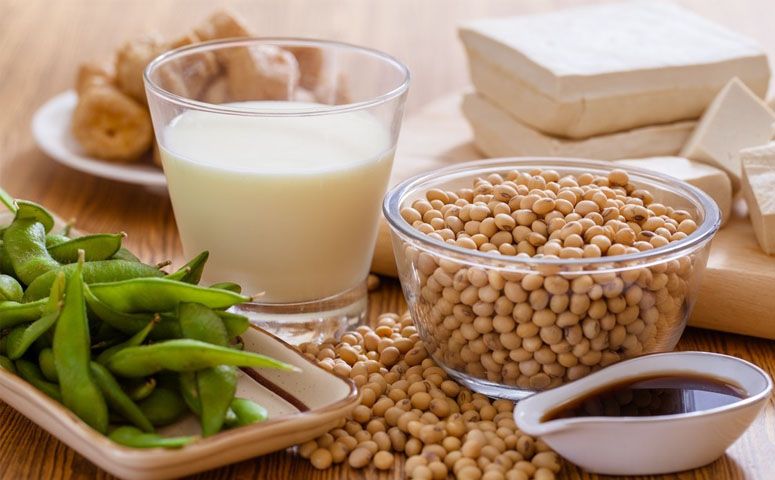
Soy is everywhere these days and has been touted as a health food that can be used as an alternative to cows milk. Health claims include its ability to regulate hormones, reduce hot flushes during menopause and reduce the risk of breast cancer. But how much of this is based on evidence, and with soy in so many of our foods, are we having too much and in the wrong form?
One of the reasons that soy has been studied so extensively is because it contains some compounds called genistein and diadzein which are isoflavones. These isoflavones have an oestrogenic effect and some believe they can be beneficial by binding to receptors and either increasing or decreasing oestrogen accordingly.1
Some soy-based foods and their approx isoflavone content:
| Food product | Genistein (mg/100g) |
Diadzein (mg/100g) |
Total isoflavones (mg/100g) |
| Soy Infant Formula (powder) | 13.5 | 6.32 | 26.3 |
| Edamame beans | 22.6 | 20.3 | 48.9 |
| Miso | 23.2 | 16.4 | 41.5 |
| Silken tofu | 8.4 | 9.2 | 18.0 |
| Raw tofu, regular | 13.0 | 9.0 | 23.0 |
| Textured soy flour | 89.4 | 67.7 | 172.6 |
| Soy protein isolate | 57.0 | 31.0 | 91.0 |
| Soy-based sliced cheese | 6.5 | 5.1 | 14.5 |
| Soy-based burgers | 5.0 | 2.4 | 6.4 |
Values obtained from the USDA Database on the Isoflavone Content of Selected Foods.2
It is important to differentiate between traditional Asian soy products such as miso, natto and tempeh, which are fermented, whole soy, and the western processed version which involves a chemical extraction, such as soy protein isolate, soy flour, infant formula and other processed foods. The beneficial results seen in Asian populations are usually from small amounts of tofu or fermented soy.3 It has been shown that fermenting soy increases the availability of the isoflavones daidzein and genistein.4
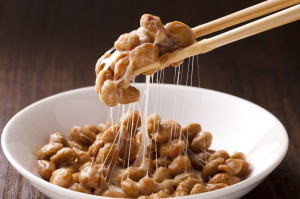
Natto which is particularly high in vitamin K2.
A lot of the studies are done by giving rats or mice isolated isoflavones, which although can give an indication of potential effects, cannot be compared to a human eating whole and/or fermented soy. Also, fermented soy contains healthful probiotics which produce beneficial enzymes. Natto, for example, produces high levels of vitamin K2 through the fermentation process, which is important for heart, brain and bone health.
PCOS
The studies on affects of isoflavones on PCOS are somewhat varied. A 2011 study gave half of the 146 subjects 36mg of genistein supplementation daily and the other half a placebo. They concluded that isolated genistein may prevent metabolic disorders in PCOS patients by improving their reproductive hormonal and lipid profiles.5
Miso, natto and tempeh are traditional fermented soy and are very different to the processed version which involves a chemical extraction.
But then in another study 6 pre-menopausal women took 45mg isoflavones per day for 1 month. This “significantly increased follicular phase length and/or delayed menstruation and mid-cycle surges of luteinizing hormone (LH) and follicle-stimulating hormone (FSH) were significantly suppressed”.6 As PCOS sufferers often have low levels of FSH and LH and don’t experience the surges needed to ovulate normally, high levels of soy does not seem like a wise choice.
A 2009 meta-analysis concluded that, “in pre-menopausal women, isoflavone intake increases cycle length and suppresses LH and FSH levels”.7 With so many women suffering from painful, heavy periods and hormone-related symptoms, I would not recommend consuming high quantities of soy without careful consideration. Hormones require such a delicate balance, so I would not recommend using soy isoflavone supplementation or having a high intake of soy in the diet as a way of addressing hormonal issues. There are far better methods that have more evidence behind them.
Thyroid health
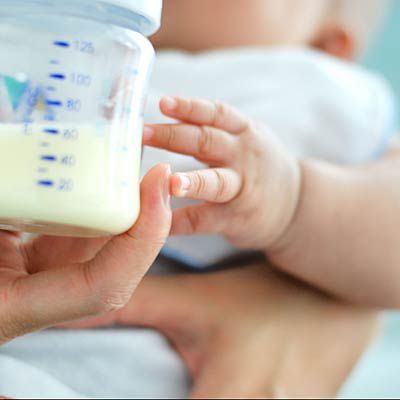
It’s time to challenge whether soy based formula is healthful or harmful.
Soy is problematic for the thyroid for a number of reasons:
- The isoflavones in soy block the activity of Thyroid Peroxidase (TPO) enzyme which causes a reduction in the production of thyroid hormones.8
- There is some evidence that children fed soy formula suffer from increased autoimmune thyroid disease.9 As you can see from the table above, infant formula contains high levels of isoflavones which can cause hormonal changes in a baby. Soy is an allergen in some children causing excess stimulation of the immune system. Thyroid activity is vitally important for life and controls growth and metabolism. As someone with an underactive/completely inactive thyroid and on life long medication, I know what it’s like to live with the condition and it’s challenging to say the least. As there is no need to give infants soy, I would rather see the introduction of soy at a much later stage, if at all, and certainly not in formula.
- Soy products are heavily marketed as providing relief from menopausal symptoms, but there is little evidence of this.10 The problem here is that women over the age of 50 are more likely to suffer from thyroid issues, therefore adding soy to the mix could exacerbate the problem.
Menopause
The phytoestrogenic effect of isoflavones are often considered to reduce hot flushes and night sweats leading many to drink soy milk. In a 2009 review of all published randomized controlled trials, the efficacy of isoflavone supplements were analysed to see if they reduce hot flushes in menopausal women. The results concluded that “isoflavone supplements do not consistently show a reduction of flushes after treatment”.11 One study seemed to show positive results with a reduction of hot flushes in 10-20% of the women when taking 30mg soy isoflavones or 15mg of genistein.12 Due to the lack of conclusive evidence and the added risk of thyroid issues, I would not suggest soy as a way to reduce hot flushes and night sweats.
Osteoporosis
One of the risks, which can accelerate during perimenopause, is progressive loss of bone-mineral density. Use of isoflavones for the reduction of osteoporosis risk does seem to be an area that has more conclusive studies. For example, a 2003 study concluded that diets rich in phytoestrogens have bone-sparing effects in the long term13 and another study found a 2.4% increase in lumbar spine bone-mineral density following ingestion of an isoflavone-rich soy milk over 2 years14 The women who had positive results in the study were able to convert daidzein to equol which is required for the beneficial effects of the isoflavones. Some people will not be able to convert the isoflavones to a useable form in the body.
Cancer
Some animal studies have shown a link between soy and cancer. Daidzein and genistein were associated with an increase in the incidence of vulvar carcinomas in mice.15 A further study on rats concluded that exposure to genistein for two years caused tumours of the mammary gland and pituitary gland in female rats.16
When looking at the evidence of the protective effects from isoflavones for hormone related cancers, specifically breast cancer, the results are very mixed and no clear conclusion can be gleaned. Some studies show proliferative effects and others anti-proliferative. A 2009 review of the effect of genistein on cancer and cancer risk, in vitro, preclinical, and clinical studies summarised that “genistein does not act by a single mechanism to achieve its effects. More studies are required to fully elucidate the mechanism of action of isoflavones, particularly genistein, including effects on oestrogen metabolizing enzymes, cell cycle, cell differentiation, proliferation, apoptosis and the inflammatory response”.17 Due to the lack of conclusive evidence, I would choose not to use soy for the purpose of protection against cancer.
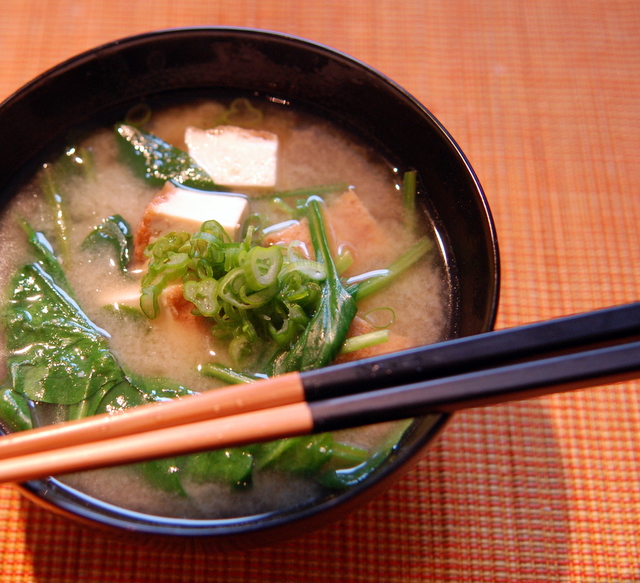
Fermented Miso Soup
Conclusion
I’m not suggesting that all soy is bad, in fact as I mentioned above, some fermented soy can be beneficial in some instances. However, personalised nutrition is about finding what is right for you. If you suffer from hypothyroidism, have an autoimmune disease and/or hormone related conditions, soy is probably not going to be the best choice. If you are in good health you might find non-GMO, organic, fermented soy to be a tasty addition to your diet and will add some protein and good bacteria with some much needed variety.
As with anything you eat, real, whole food is best. There are few instances where I would suggest nutrients in isolation. Taking an isolated nutrient such as genstein or daidzein in a supplement will mean the synergy of nutrients in the soy is lost.
You can’t change the truth,
but the truth can change you!

References
- http://lpi.oregonstate.edu/mic/dietary-factors/phytochemicals/soy-isoflavones
- Patisaul HB, Jefferson W. (2010). The pros and cons of phytoestrogens. Front Neuroendocrinol. 31 (4), 400–419.
- Barrett J. (2006). The Science of Soy: What Do We Really Know? Environmental Health Perspectives. 114 (6).
- Hutchins AM, Slavin JL, Lampe JW. (1995). Urinary isoflavonoid phytoestrogen and lignan excretion after consumption of fermented and unfermented soy products. Journal of the American Dietetic Association. 95 (5), 545-51.
- Khani B, Mehrabian F, Khalesi E, Eshraghi A. (2011). Effect of soy phytoestrogen on metabolic and hormonal disturbance of women with polycystic ovary syndrome. Journal of Research in Medical Sciences. 16 (3), 297–302.
- Cassidy A, Bingham S, Setchell KD. (1994). Biological effects of a diet of soy protein rich in isoflavones on the menstrual cycle of premenopausal women. The American Society for Clinical Nutrition. 60 (3), 333-340.
- Hooper L, Ryder JJ, Kurzer MS, Lampe JW, Messina MJ, Phipps WR, Cassidy A. (2009) Effects of soy protein and isoflavones on circulating hormone concentrations in pre- and post-menopausal women: a systematic review and meta-analysis. Human Reprod. Update.15:423–440.
- Chang HC, Doerge DR. (2009) Dietary genistein inactivates rat thyroid peroxidase in vivo without an apparent hypothyroid effect. Toxicol Appl Pharmacol 168:244–252.
- Fort P, Moses N, Fasano M, Goldberg T, Lifshitz F. (1990) Breast and soy-formula feedings in early infancy and the prevalence of autoimmune thyroid disease in children. J Am Coll Nutr 9:164–167.
- Duncan AM, Underhill KE, Xu X, Lavalleu J, Phipps WR, Kurzer MS. (1999) Soy isoflavones exert modest hormonal effects in premenopausal women. J Clin Endocrinol Metab 84:192–197 (1999).
- Jacobs A, Wegewitz U, Sommerfeld C, Grossklaus R, Lampen A. (2009) Efficacy of isoflavones in relieving vasomotor menopausal symptoms – a systematic review. Mol. Nutr. Food Res.53:1084–1097.
- Kurzer MS. (2003) Phytoestrogen supplement use by women. The Journal of Nutrition.133:1983S–1986S.
- Setchell KD, Lydeking-Olsen E. (2003) Dietary phytoestrogens and their effect
Categorised in: Health Care, Nutritious Roots Blog
March 3, 2016 11:41 pm
Comments are closed here.