What’s your gut feeling? Part 1


It’s strange to think we are made up of trillions of bacteria and that we have more bacteria than human cells. But what does this bacteria do and why is it so important?
Probiotic bacteria covers the surface of our nine metre digestive system from our mouth, through our oesophagus, into our stomach, right through to our small and large intestines.
All disease begins in the gut.
Hippocrates (460 – 370 BC)
Digestion
The beneficial bacteria are vital for the effective digestion and absorption of our food and produce enzymes that break down proteins, carbohydrates, fats and fibre. The beneficial bacteria enables the body to convert food into nutritious substances for our gut lining and produces material that transports the minerals, vitamins and nutrients through the gut wall. Therefore, lack of healthy gut flora can lead to many deficiencies. For example, homocysteine is a chemical which is produced when we are deficient in vitamins B6, B12 and folic acid. Having high homocysteine is linked to many conditions including heart disease.1
We have approx 100,000,000,000,000
(100 trillion) micro-organisms in our gut.(2)
Immunity
Over 75% of our immunity is located in the gut wall and is called Gut-Associated Lymphoid Tissue (GALT). The beneficial bacteria in the gut wall creates a healthy, balanced immune system where the body can defend itself against things like chemicals, dust, animals and food. It produces natural antibiotic, anti-fungal and antiviral properties that fight off infection and protect the beneficial bacteria. The good bacteria also binds to heavy metals such as mercury, lead and aluminium to prevent them from harming your system.3
When the immune system is not working effectively it can become overactive and cause health problems such as asthma, hayfever, eczema, rheumatoid arthritis, osteoarthritis, multiple sclerosis, type 1 diabetes, lupus, Crohn’s disease, hypothyroidism and hyperthyroidism. Unfortunately the list of problems is endless.
Another problem that is becoming more common is ‘leaky gut’ where the integrity of the gut wall is compromised and substances escape into the blood stream causing an immune response. It has now been shown that this can cause autoimmune diseases4 and is linked to many conditions including mental disorders and allergies.
The gut is not like Las Vegas. What happens in the gut does not stay in the gut.
Dr. Alessio Fasano
The answer to all these problems is to give your body the best chance of having healthy, diverse gut flora. I will explain how you can do this, but first lets look at what destroys healthy gut flora or prevents it from being healthy and diverse at birth.
What’s causing the damage?
Bacterial imbalances, also known as dysbiosis, are extremely common. If you are unwell and/or have a health condition you can be fairly sure that you need to address your gut.
Dysbiosis is common due to:
- Overuse of antibiotics5
- Oral Contraceptive Pill (OCP)6,7 The OCP has also been associated with an increased risk of Crohn’s Disease, a painful inflammatory bowel condition8.
- Other drugs – antacids, NSAID painkillers such as ibuprofen and aspirin (overuse can also cause gastric and duodenal ulcers9), sleeping pills, anti-depressants, neuroleptics, cytotoxic drugs, cholesterol drugs and many more……
- Diets high in sugary, highly processed carbohydrates and grain.
- Bottle-fed babies who were not breastfed and not given probiotics
- Disease – bacterial and viral illnesses
- Long-term stress
- Alcohol
- Toxic substances such as non-organic food, pollution, heavy metals
- Exposure to radiation
- Lack of sleep
 When a mother gives birth she will pass on her gut flora to her baby through the birthing canal, so it’s important she has healthy gut flora herself. If a mother has a caesarean section it is even more important to breastfeed the baby. If a natural birth and/or breastfeeding isn’t possible, which is sometimes unavoidable, it is integral to develop the baby’s gut flora with a baby probiotic, and once weaned, through a healthy diet of freshly-made organic or home grown food. Is it common for children to be in relatively good health when they are breastfeeding, but when formula is started, issues develop such as recurrent ear infections, chest infections and eczema. They are then given antibiotics or steroids which further damage their delicate system. Antibiotics kill the bad bacteria as well as the good. As they get older and are exposed to the typical western diet rich is processed and refined carbohydrates and grain, and lacking in nutrient-dense food, the problem worsens.
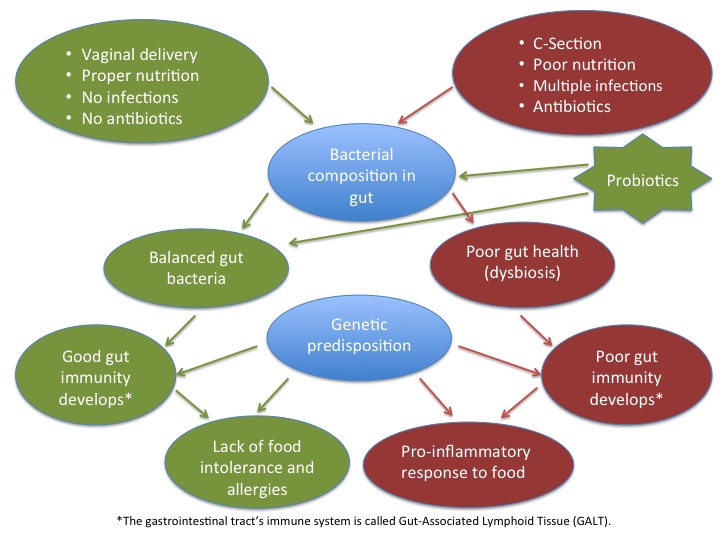
Adapted from a slide presented by Dr. Alessio Fasano
From here I would like to give a little insight into what happened to me. Many teenage girls are put onto the oral contraceptive pill (OCP) for bad skin. At 17 years old this was the case for me. I continued to take it into adulthood because the doctor continued to prescribe it and I had no knowledge at this time that it could be damaging my health. No side effects were ever mentioned. I began to suffer from depression and fatigue, which I believe was due to the OCP. The pill alters the diversity of gut flora and causes depletions of some of the B vitamins including folic acid, vitamin C, magnesium, selenium and zinc. These nutrients are needed for the immune system, mental health, energy, thyroid function and ironically for a healthy menstrual cycle. I’d been taking thyroid medication since the age of 11, but unfortunately my thyroid function was never addressed at a deeper level to understand what part of the pathway was failing. Add these deficiencies to an already distressed body system and it was a recipe for disaster. A link was never made between my poor health and the medications I was taking and I continued to suffer with infections, colds, general poor immunity, kidney infections, mumps, IBS and so on. Of course everyone gets ill occasionally, but if you’re already starting off on the back foot it takes far longer to recover. I had a virus one Christmas and it took me 4 weeks to recover. I share this to make the point that my case is not isolated. When I speak to friends, colleagues and in my clinic I hear similar experiences and many can relate and share similarities.
Later in life you develop other health issues such as high blood pressure, heart burn and ulcers, depression and other brain-related diseases, insomnia and joint pain and are prescribed a cocktail of drugs to ease your discomfort without ever getting to the root of the problem. These are just examples but worryingly it happens all too often. Prescription medication kills 10,000 people a year in the UK due to adverse drug reactions (ADRs) with the most common reaction being gastrointestinal bleeding.10 These are instances when the medication is being taken as per the recommended dose.
This article gives you the bad news but it’s not all doom and gloom. Watch out for PART 2 which will follow tomorrow and contains all the good news – hurray! There will be lots of positive steps you can take to support your gut health.
Love your gut. Heal your gut. Heal yourself.
Dr. Amy Myers
References
- M.D. Silverman et al. ‘Homocysteine upregulates vascular cell adhesion molecule-1 expression in cultured human aortic endothelial cells and enhances monocyte adhesion’, Thrombosis & Vascular Biology, vol. 22 (2002), pp.587-92.
- Bäckhed F, Ley R.E., Sonnenburg J.L. et al. (2005). Host-Bacterial Mutualism in the Human Intestine. Science. 307 (5717), 1915-1920.
- Monachese M, Burton J, Reid G. (2012). Bioremediation and Tolerance of Humans to Heavy Metals through Microbial Processes: a Potential Role for Probiotics? Applied and Environmental Microbiology. 78 (18), 6397–6404.
- Fasano A, Shea-Donohue T. (2005). Mechanisms of Disease: the role of intestinal barrier function in the pathogenesis of gastrointestinal autoimmune diseases. Nature Clinical Practice Gastroenterology & Hepatology. 2 (9), 419-422.
- Dethlefsena L, Relman D. (2010). Incomplete recovery and individualized responses of the human distal gut microbiota to repeated antibiotic perturbation. Department of Microbiology and Immunology and Department of Medicine. 108 (1), 4554–4561.
- Webb, JL. (1980). Nutritional effects of oral contraceptive use: a review. The Journal of Reproductive Medicine. 25 (4), 150-156.
- http://www.chiro.org/nutrition/ABSTRACTS/Nutrient_Depletion_Checklist_Oral_Contraceptives.shtml
- Khalili H, Higuchi LM, Ananthakrishnan AN et al. (2013). Oral contraceptives, reproductive factors and risk of inflammatory bowel disease. International Journal of Gastroenterology and Hepatology. 62 (8), 1153-1159.
- Thompson, W.G. (2009). NSAIDs: Good for the Joints, Bad for the Gut?. International Foundation for Functional Gastrointestinal Disorders.
- Pirmohamed M, James S, Meakin S, et al. (2004). Adverse drug reactions as cause of admission to hospital: prospective analysis of 18 820 patients. British Medical Journal. 329 (7456), 15-19.
Other sources:
- Clinical Nutrition A functional approach, DeAnn Liska, PhD, Sheila Quinn, Dan Lukaczer, David S. Jones, Robert H. Lerman, MD, PhD
- Introduction to Human Nutrition, Second Edition, Michael J Gibney, Susan A Lanham-New, Aedin Cassidy, Hester H Vorster
- http://www.medical-hypotheses.com/article/S0306-9877(04)00496-7/abstract
- http://www.pointofreturn.com/gut_health.html
- http://www.virginiahopkinstestkits.com/everywomanbc.html
- http://albertparknaturopathy.com.au/the-real-cost-of-the-oral-contraceptive-pill-ocp
Categorised in: Health Care, Nutritious Roots Blog
September 12, 2015 11:58 pm Leave your thoughts